
Trance vs Techno: What's the Difference?
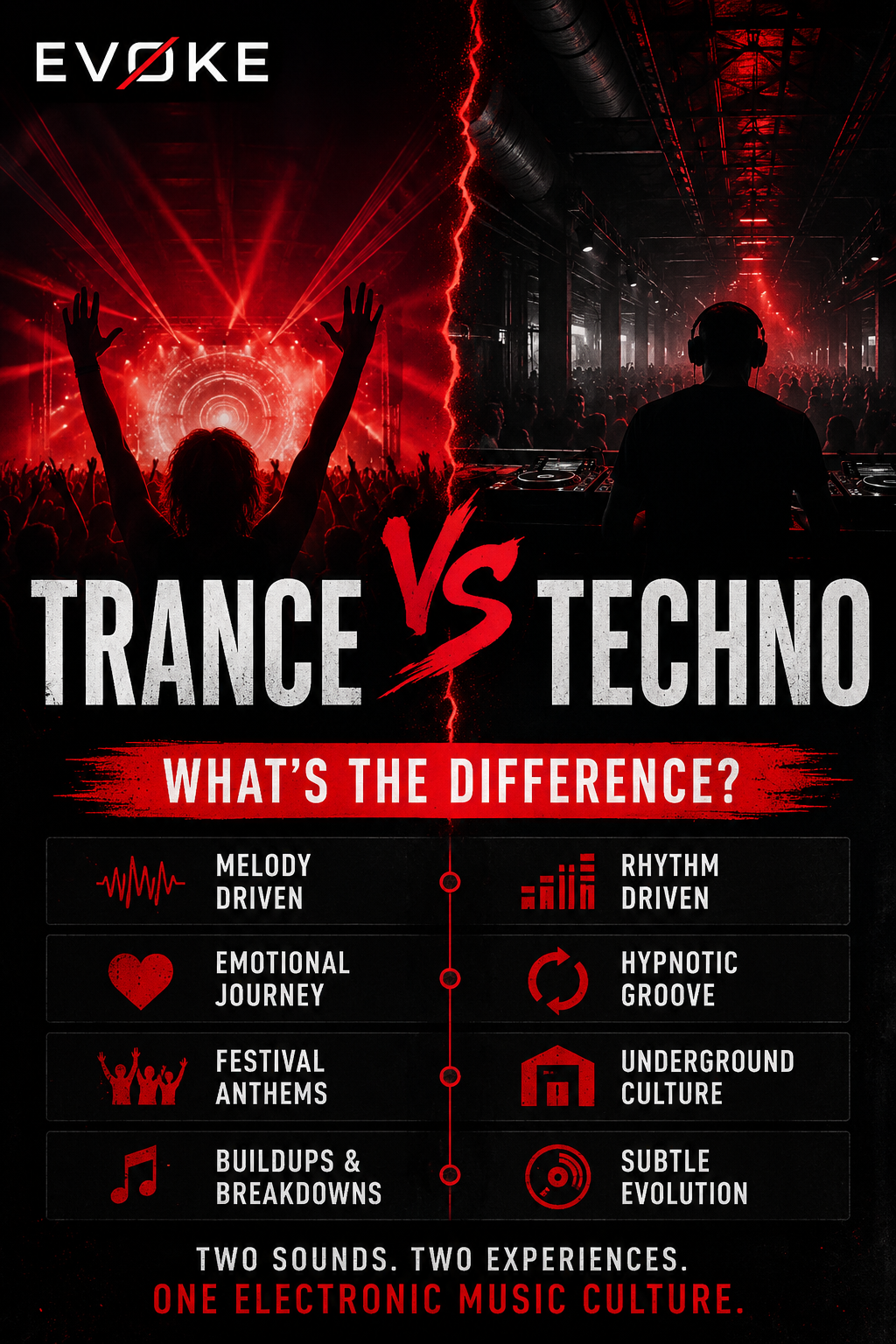
If you have ever told someone that you listen to trance music chances are you have heard the response:
"Oh like techno?"
This is one of the misconceptions in dance music. To millions of listeners everything with a four-on-the-floor beat gets labeled as techno.. Ask anyone who has spent time at underground clubs, massive festivals or late-night warehouse parties and you will quickly learn that trance and techno are two completely different experiences.
Trance and techno share some things in common. Both rely on rhythms. Both can keep a dance floor moving for hours.. When it comes to emotions and art, trance and techno are often worlds apart.
One type of music tries to hypnotize you with rhythm. The other type of music tries to make you feel something bigger.
Lets talk about what separates these two genres.
A Quick History of Techno
Techno started in Detroit during the 1980s. Artists like Juan Atkins, Derrick May and Kevin Saunderson combined synthesizers with funk, electro and machine-driven rhythms. The result was something new. It was mechanical, minimal and forward-thinking.
As techno spread across Europe cities like Berlin changed the genre. Dark warehouses, industrial buildings and marathon DJ sets helped shape the sound into something more hypnotic.
Today techno is incredibly diverse. You have driving peak-time techno, melodic techno, industrial techno, acid techno, hard techno and countless underground variations.. Most styles still prioritize groove over melody. That's the point. The rhythm is the star.
Where Trance Came From
Trance emerged a little later. During the 1990s producers in Germany experimented with longer melodic arrangements that borrowed ideas from techno while adding atmosphere, emotion and evolving harmonies.
Artists began stretching songs beyond seven or eight minutes. Of simply making people dance they wanted listeners to feel transported. Over time trance evolved into one of musics most emotional genres. It has uplifting melodies, massive breakdowns and goosebump-inducing buildups.
The kind of music that can make thousands of strangers throw their hands into the air at the same moment. That's difficult to describe unless you have experienced it.
The Biggest Difference: Emotion
If someone asked me to explain the difference in one sentence I would say this: Techno makes you move, trance makes you feel. That's obviously an oversimplification. There are techno records and there are darker trance tracks.. Generally speaking the emotional focus is very different.
Techno keeps you locked into the groove. It's repetitive in the possible way. Every subtle change matters because the hypnotic rhythm never really lets go. Trance builds tension it releases it then it builds it again. The emotional highs are more dramatic. Sometimes almost cinematic.
Melody vs Rhythm
This is where the genres really begin separating themselves. Techno melodies usually play a supporting role. Instead producers focus on drum patterns, percussion, texture, atmosphere, bass movement and sound design. A techno producer might spend hours perfecting a hi-hat pattern that casual listeners barely notice.
Trance is different. Melody is everything. The lead synth often becomes the identity of the song. Layer after layer builds until the breakdown arrives stripping everything away before unleashing an emotional payoff. If techno feels like machinery operating trance feels like watching the sunrise after staying awake all night.
BPM: Which Genre Is Faster?
This surprises a lot of people. Techno and trance are actually closer than most assume. Typical techno ranges from around 125 to 140 BPM although harder styles often climb above that. Trance generally sits between 130 and 150 BPM sometimes even faster, with uplifting trance landing around 15 BPM.
Tempo alone does not tell the story. A 140 BPM trance track often feels lighter because of its melodies. A 130 BPM techno track can feel relentless because of the driving percussion. Perception matters as much as numbers.
Song Structure
Trance tracks usually follow a journey. Something like this: intro, progressive buildup, first drop, breakdown, emotional climax, final release, outro. The breakdown is often the defining moment. Vocals may appear pads fill the space. Everything builds toward one unforgettable release.
Techno rarely follows that formula. Instead tracks evolve gradually. Changes happen invisibly. New percussion arrives, a synth enters the bass shifts and nothing feels forced. It simply keeps flowing. That's why techno DJs can blend tracks together for periods without interrupting the energy.
Vocals
Here's another difference. Trance frequently includes vocals. Sometimes they're songs sometimes they're little more than haunting phrases floating above the mix. Think of classics that give listeners chills years after release. Vocals often become part of the experience.
Techno is less likely to have vocals. Many techno tracks contain no vocals whatsoever. Others use chopped samples more as rhythmic elements than storytelling devices. Words become instruments, not lyrics.
The Club Experience
Walking into a trance event feels different. There's anticipation people sing along hands rise during breakdowns and crowds cheer before the biggest drop even arrives. It feels almost communal everyone experiences the moments together.
A techno club has an energy. The room often stays darker the lights remain minimal people lose themselves individually while still dancing together. Conversation disappears movement takes over it's less about spectacle, more about immersion. Neither experience is better they're simply moods.
Production Style
Lets talk about what producers focus on. Trance producers spend amounts of time creating huge supersaw leads, atmospheric pads, emotional chord progressions, long risers, sweeping effects and wide stereo imaging. Everything aims to create space the mix often feels enormous.
Techno producers obsess over details. Think kick drum punch, groove, swing, texture, analog saturation, percussion layers, repetition. Of asking, "How beautiful can this melody become?" they're asking, "How long can I keep people locked into this groove?" Different goals, results.
Festival Sets vs Underground Clubs
This is where stereotypes start appearing. Trance has historically embraced festivals, huge stages, pyrotechnics, epic visuals, emotion on a gigantic scale. Techno meanwhile built much of its identity inside clubs and warehouse spaces.
Course those lines are becoming blurrier every year. Large techno festivals now attract audiences melodic techno artists regularly headline major events. Progressive trance often feels closer to techno than classic uplifting trance. Electronic music never stops evolving honestly that's part of what makes it exciting.
Can You Like Both?
Absolutely many fans do. Some weekends call for melodies others call for hypnotic grooves that don't let your brain think for six straight hours. Your playlist doesn't need to pick a side mine certainly doesn't. One minute I'm listening to soaring trance, the dark Berlin techno with almost no melody at all. Context changes everything.
Artists That Define Each Genre
Famous Trance Artists
Some of the names include: Armin van Buuren, Above & BeyondFerry Corsten, Aly & Fila Cosmic Gate, Giuseppe Ottaviani, Gareth Emery Paul van Dyk. Each brings an approach but emotional storytelling remains central to their music.
Famous Techno Artists
Some legendary names include: Charlotte de Witte, Adam Beyer, Amelie Lens, Carl Cox, Richie Hawtin, Jeff Mills, Ben Klock, Nina Kraviz. While their styles vary considerably groove and rhythm stay at the forefront.
Why People Confuse Them
The answer is simple. To someone with electronic music both genres feature repetitive beats both use synthesizers both often avoid traditional verse-chorus songwriting both exist inside the broader EDM umbrella. So it's understandable. Once you spend time listening though the differences become obvious.
After a while you can usually identify a techno track within seconds. The same goes for trance your ears start recognizing the language each genre speaks.
Which Genre Is Better?
That's the question. Music isn't a competition. Techno succeeds because of restraint trance succeeds because of release. One embraces evolution the other welcomes dramatic emotion. Some nights I want grooves that blur time completely other nights I want melodies that make the hairs on my arms stand up.
There's room for both actually electronic music would be much poorer, without either one.
Final Thoughts
Trance and techno may share roots but they've grown into two distinctly different forms of electronic music. Techno is driven by rhythm, repetition and hypnotic movement it invites listeners to disappear inside the groove, where small changes carry weight. Trance takes an emotional path sweeping melodies, soaring breakdowns and uplifting climaxes create moments that feel almost cinematic turning a dance floor into a shared emotional experience.
Electronic music has two types that're really popular. One type is not better than the type. They are just different. Some people like the beat of music in a big room. Other people like the feeling of music at a festival when the sun is coming up. Both types of music are important to the history of music.
The best thing to do is to listen to music without thinking it will be bad or good. Try both types of music. You might find that you like one type of music when you are out at night because it makes you feel a certain way. The type of music is not as important as how it makes you feel. Electronic music is, about the feeling you get from listening to it.
